 Rapidemo
Editing
Last updated:
After recording, your project opens in the editor: a live preview, a timeline with automatic zoom animations, and properties for everything you select.
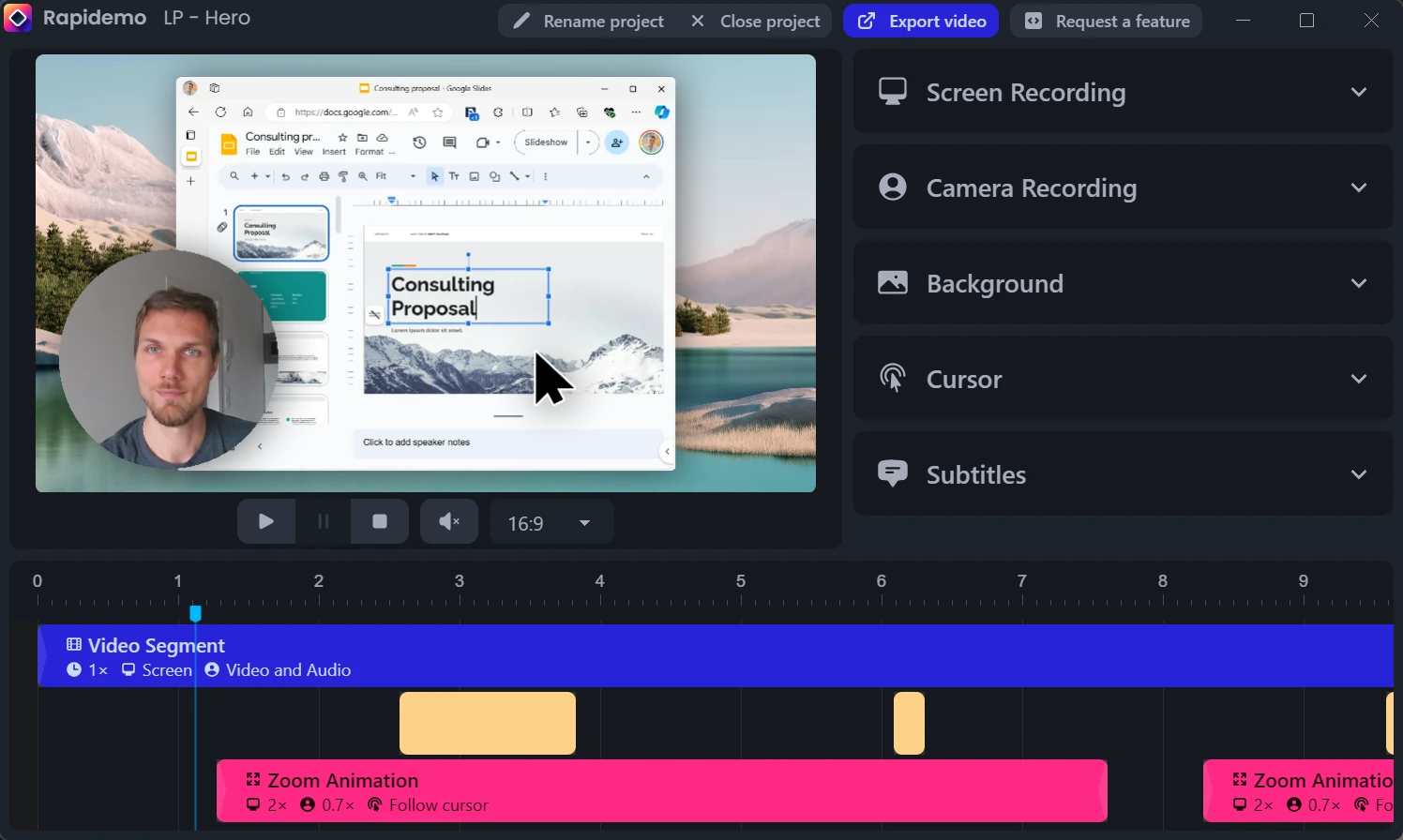
The editor has three areas: the preview, the timeline, and the properties next to the preview. Everything you change updates the preview in real time, every edit can be undone with ctrl z and redone with ctrl y, and your project saves automatically. New to Rapidemo? Read how projects work first.
Timeline editor
Edit Clips, Zooms, Clicks, Subtitles and Masks on the timeline. Scrub by dragging the playhead or by clicking on the time scale at the top of the timeline.
Scroll the timeline horizontally with the scrollbar at the bottom, by holding shift while scrolling, or with the ← and → keys.
Preview playback controls
Use the buttons below the preview to Play, Pause, Stop and Mute the preview, or press space to play or pause. Muting only silences the preview, not the export.
Don’t worry if the preview stutters during playback. The exported video will be smooth.
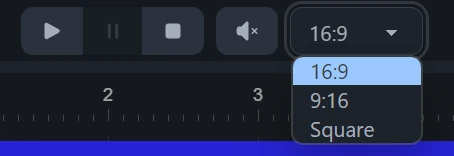
Aspect ratio and Loop cursor
The transport bar next to the playback controls holds the two project-wide controls: the aspect ratio and Loop cursor.
Switch the aspect ratio at any point to see your video in a different format. The screen and camera recordings and all zoom effects adjust automatically without changing your project, so one recording can become both a 16:9 video and a vertical one.
The aspect ratio preview is independent from the export. You set the final aspect ratio in the export window.
Rename project
Change the project title with the button in the title bar, or with F2. The title appears in the Recent projects list on Rapidemo’s start screen.
Default configuration
The Screen recording, Camera recording, Cursor, Transcript, Clips, Zooms and Masks properties each have a Set as default button that saves the current styling as the project’s default. Backgrounds and Scene fades have none.
New elements, and newly recorded Scenes, start from those defaults. Imported or duplicated Scenes keep their own styling.
For instance, if new zoom animations should always use a certain zoom level, set a Zoom’s properties up once and click Set as default.
To reuse defaults across projects, save them as an editor preset.